
Law Enforcement Training Coordinator's Guide
Equipping Your Agency with More Than Just a Class—Build a Resilient Tactical Standard
S.T.A.R.S. Matrix® is a Tactical Infrastructure that combines advanced neuroscience training, objective body-cam performance reviews, and a long-term field support network. We provide the permanent framework required to elevate your agency's crisis response and dramatically reduce liability.
The Biological Wall
Why Traditional Communication Fails
Traditional crisis intervention (standard de-escalation) assumes the person you're speaking to can actually reason. But you've seen it: in high-arousal crises, the subject's prefrontal cortex goes offline. This is an amygdala hijack.
You cannot effectively reason with a brain in survival mode. The officer must address the biology first:
- ▸ Fight/Flight (Sympathetic): Hypervigilant, reactive, perceiving threat everywhere.
- ▸ Freeze/Fawn (Dorsal Vagal): Dissociated, unresponsive, internally disconnected.
When communication hits this biological wall, you need a different tactical tool.

The Tactical Infrastructure
S.T.A.R.S. Matrix® is an operational standard. It is a self-sustaining infrastructure of professional development and field support.
The Neuro Pillar
Biological Stabilization
Grounded in the Adaptive Brain model and the HPA axis, officers learn to identify a subject's neurological state in real time — from full prefrontal access down to survival-only brainstem activation — and to recognize why verbal commands fail once a person is neurologically incapable of processing them. This pillar ensures officers stabilize the body before attempting to reach the mind.
The Behavioral Pillar
Function-Based Response
Built on Applied Behavior Analysis, this pillar trains officers to identify the function driving a subject's behavior — Out, Watched, Lock On, or Self-Calm (O.W.L.S.) — rather than reacting to its surface form. Performance is measured through forensic body-camera review, converting subjective after-action opinions into documented, replicable behavioral data.
The Linguistic Pillar
Relational Frame Deployment
Using Relational Frame Theory, officers learn to recognize the rigid language patterns common in crisis (blame, isolation, fixed identity, all-or-nothing thinking) and to deploy specific relational frames — Coordination, Deictic, Transformation, Metaphor, Hierarchical, and Opposition — that shift a subject's verbal relationship to the crisis itself, opening room for de-escalation.
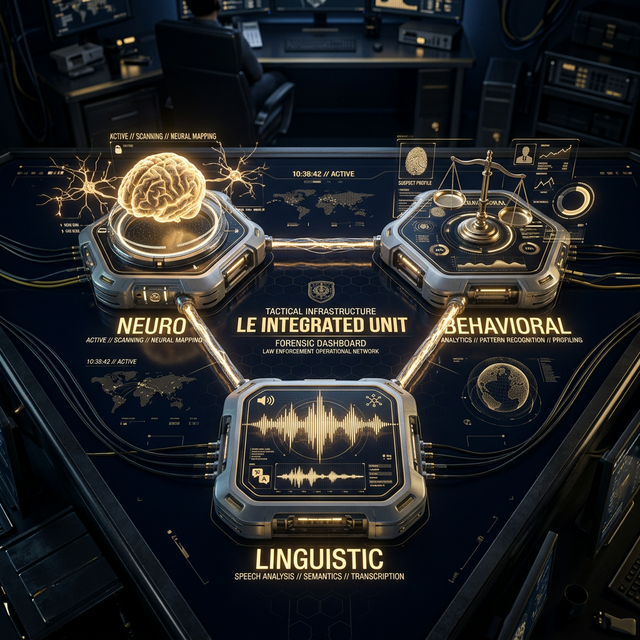
"A closed-loop system designed for the modern, high-accountability law enforcement agency."

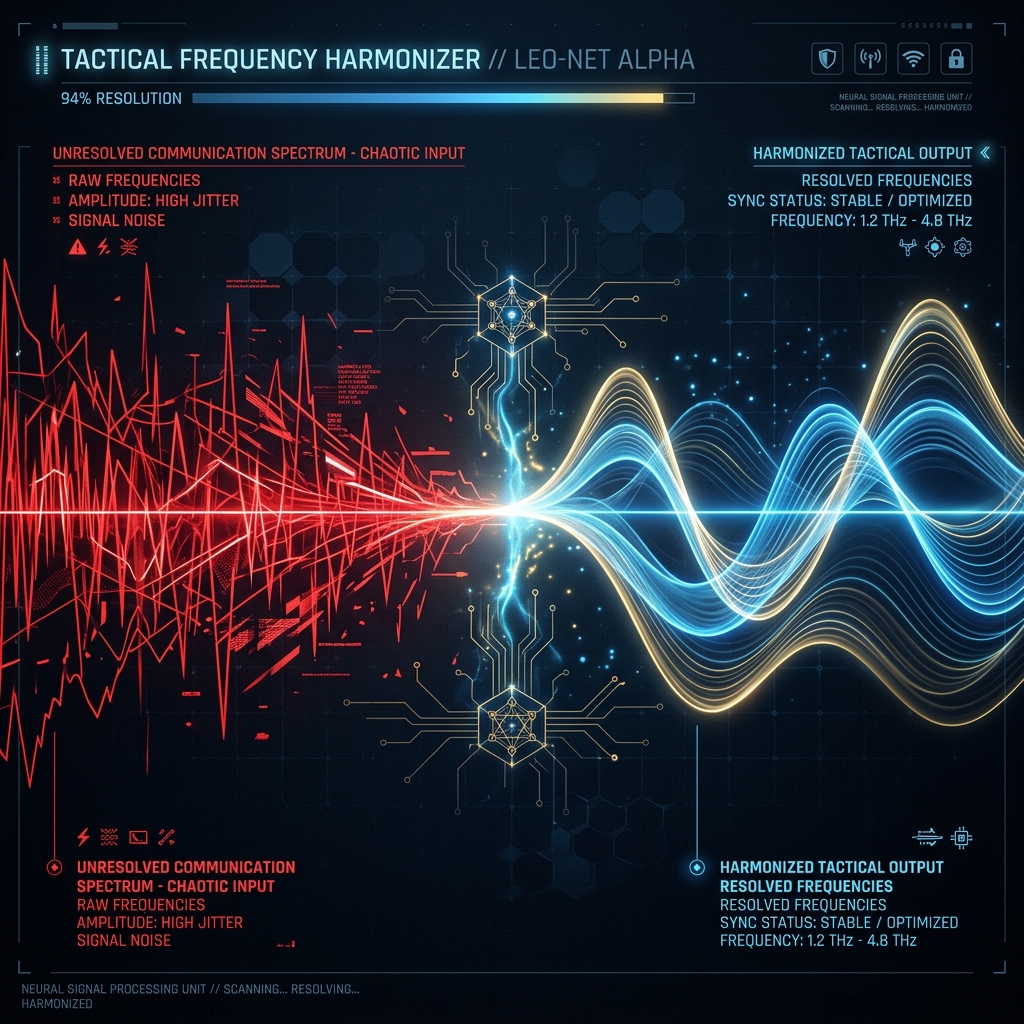
Advanced Tactical Tools
Component: Applied Linguistic Neuroscience
As part of the infrastructure, S.T.A.R.S. Matrix® provides officers with the ability to stabilize the nervous system first — then engage specific neural networks through language.
The Five Core Linguistic Frames (RFT)
Officers are trained to rapidly identify a subject's signal and deploy the matching frame:
- Coordination — Aligning the officer and the subject.
Brain Access: Amygdala & HPA Axis, plus the Mirror Neuron System & Insula. Down-regulates the threat-detection response and activates the brain's empathy circuitry ("we are the same" vs. "you are the enemy"). - Deictic — Shifting perspective safely to de-escalate tension.
Brain Access: Temporoparietal Junction (TPJ) — the Theory of Mind network. Shifts processing away from the survival brainstem and into the social-cognition centers responsible for holding "I vs. You." - Metaphor — Redirecting through story and analogy rather than direct argument.
Brain Access: Right Hemisphere Association Areas — the Analogical Processing pathway. Bypasses the left hemisphere's "logic gatekeeper," influencing behavior through imagery and association instead of confrontation. - Hierarchical — Categorizing chaotic elements into manageable priorities.
Brain Access: Dorsolateral Prefrontal Cortex (dlPFC) — the Executive Control Network. Rebuilds order and priority in a mind that has lost the ability to sequence next steps. - Temporal — Connecting present action to future resolution.
Brain Access: Ventral Striatum — the brain's Reward Prediction pathway. Triggers dopamine release tied to achievable next steps, shifting the subject from defensive avoidance toward goal-directed hope.
Opposition — The Emergency Frame
Reserved for a specific signal: a fixed, rigid identity statement ("I always... I never... that's just who I am") that the five core frames aren't shifting. Opposition is not a first-line tool — it's deployed when a subject is stuck at the level of identity itself, not just perspective or meaning.
TSF (Transformation of Stimulus Function) — How You Know It's Working
TSF is not a technique an officer deploys. It's the observable marker that a frame has succeeded — the subject's own response confirming the shift:
- ▸ Posture changes (arms uncross, pace slows)
- ▸ Tone changes (voice quiets, slows)
- ▸ Language changes (reactive → curious)
TSF is not what you changed. It's what they changed in response.
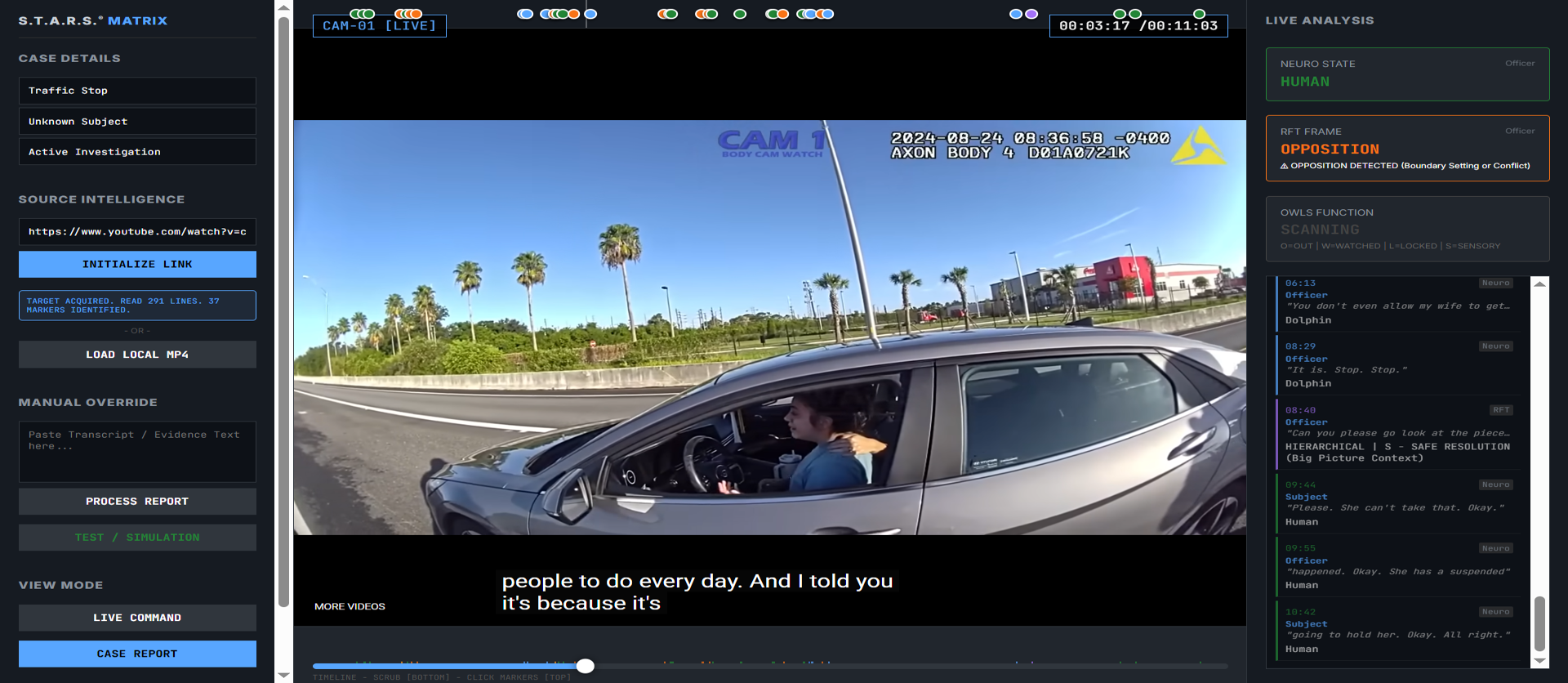
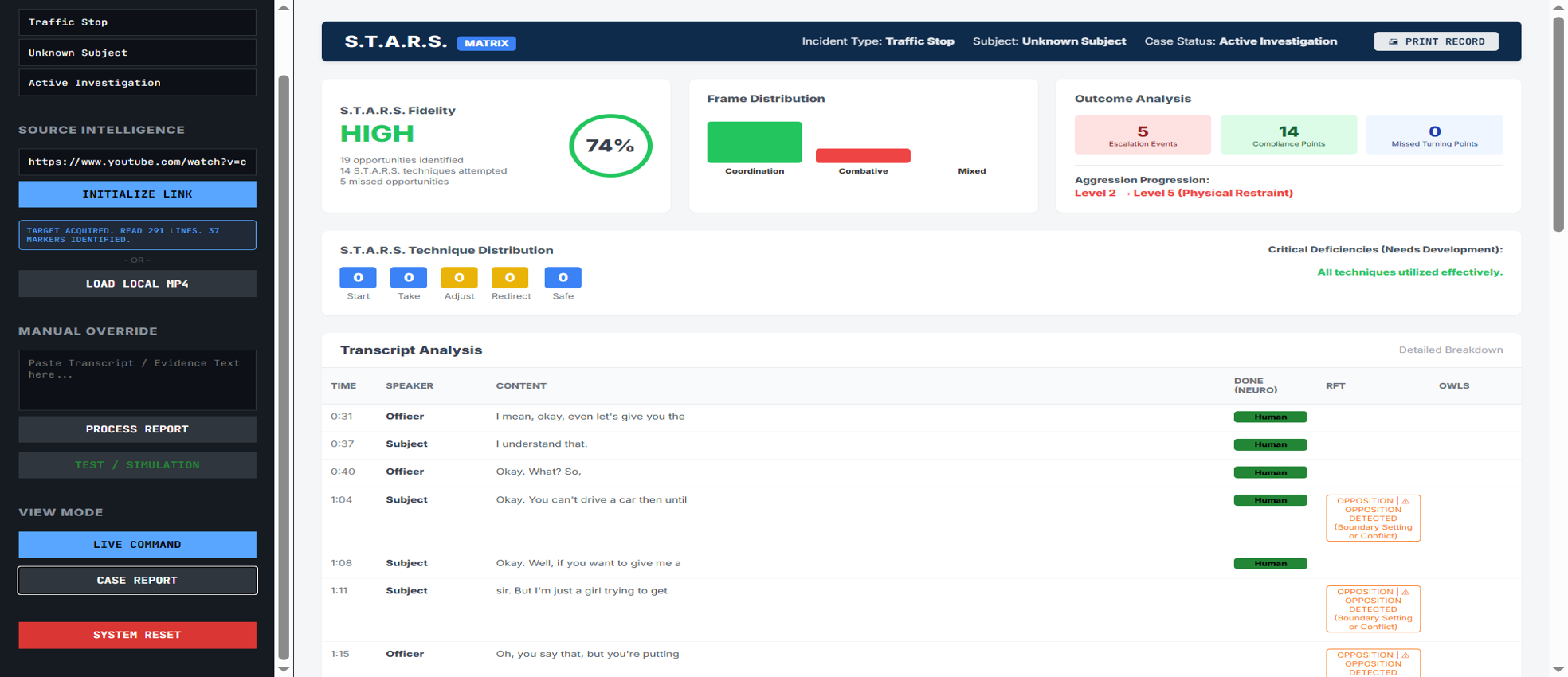
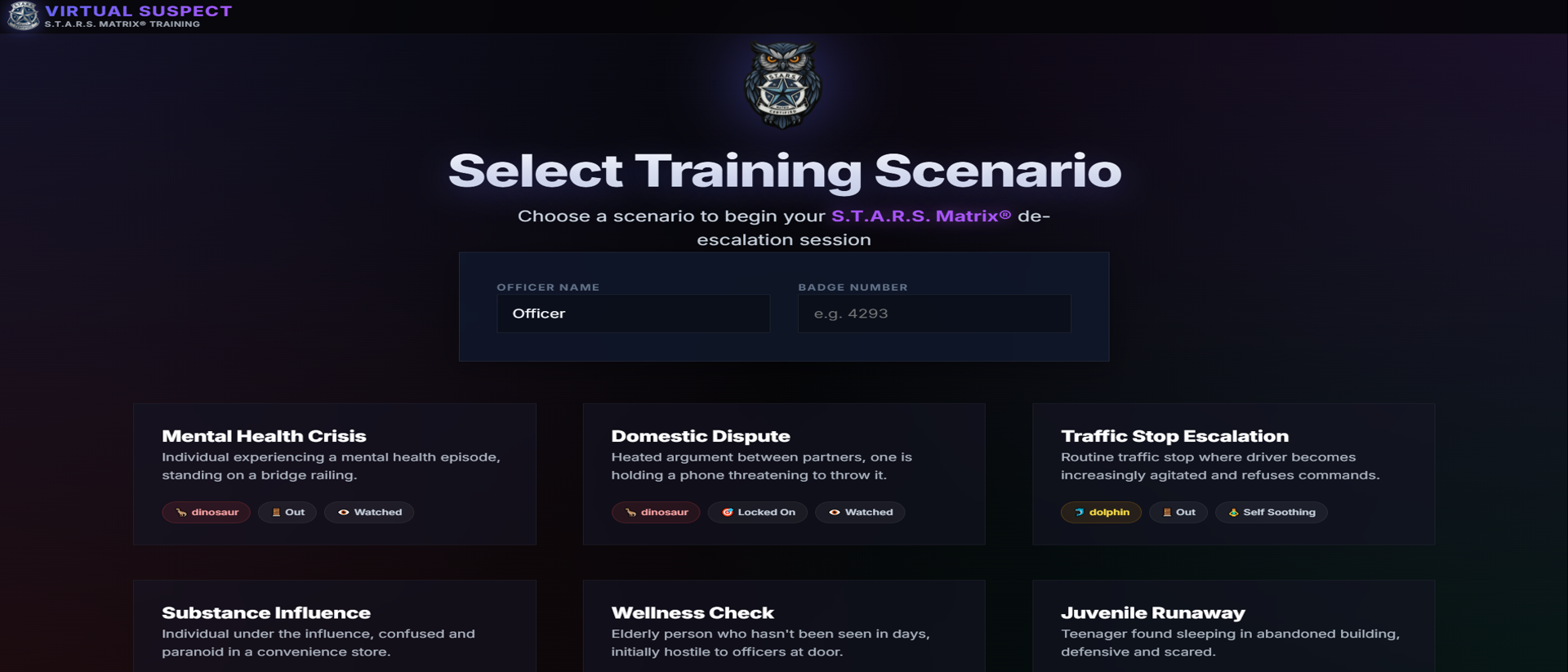
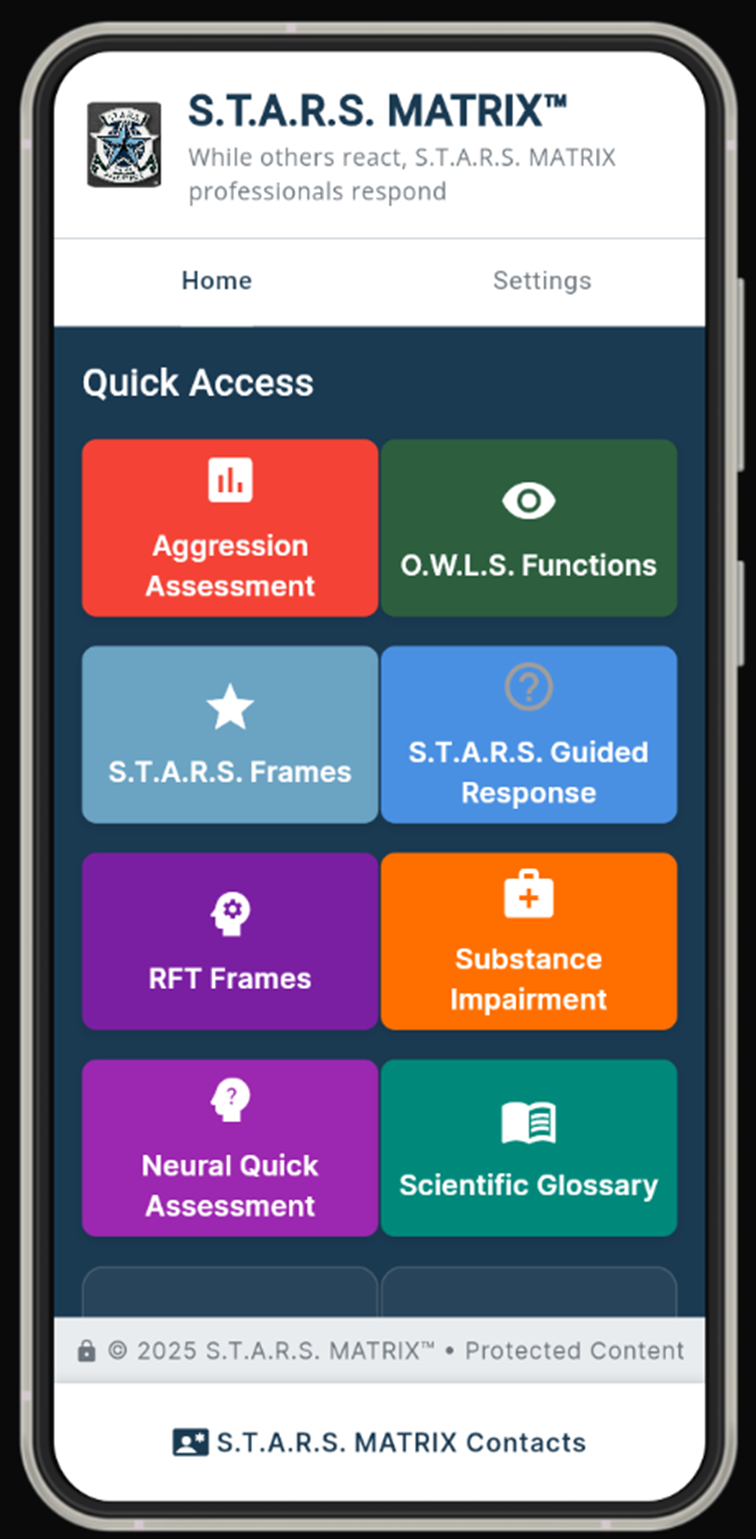
The AI-Powered Training Suite
Integrating S.T.A.R.S. Matrix® with cutting-edge artificial intelligence to provide objective measurement, interactive scenario simulation, and in-pocket field support.
5 Core Differentiators
Why agencies across the country are prioritizing human brain science to transform their crisis response.
Stabilizes the Brain First
We bypass the amygdala hijack by establishing vagal state recognition, biologically preparing the subject to hear you.
Systematic Linguistic Scripts
Not just what to say, but how specific wording alters neurobiology. Simple, repeatable scripts for intense stress.
Lowers Use-of-Force Liability
By succeeding where standard communication hits a neurobiological wall, officers have proven alternative pathways.
AI Backed Feedback
Provides non-disciplinary, AI-driven analysis of body-cam footage, objectively mapping interventions for rapid skill growth.
Radical Officer Self-Care
The exact tools used to regulate citizens are directly applied by officers to regulate their own stress and PTSD risk.
The Ultimate Partnership
S.T.A.R.S. is not a replacement for your existing training. It's the biological foundation that makes your current CIT, ICAT, and tactical communication work when it matters most.
| Synergy Component | S.T.A.R.S. Matrix® | Traditional CIT | ICAT/Vistelar |
|---|---|---|---|
| Primary Focus | Autonomic Nervous System (ANS) Regulation & Vagal State Modulation | Mental Health Awareness | Tactical Communication |
| Theoretical Foundation | Applied Neuro-Linguistics, Relational Frame Theory (RFT) & Operant Conditioning | Psychiatric Identification | Verbal Persuasion |
| Role in Crisis Timeline | Phase 1: Allostatic Load Reduction & Amygdala Deactivation | Phase 3: Resource Connection | Phase 2: Mid-Arousal Dialogue |
| The Partnership | Bypasses prefrontal cortex deficit via targeted physiological stabilization, enabling subsequent cognitive-behavioral interventions. | Provides necessary empathy and resources once the subject can process information. | Utilizes rhetoric tactics effectively after biological resistance is bypassed. |
TCOLE CEU Eligible Courses
- Essentials Training (1 Day) TCOLE# 20100
- Practitioner Certification (2 Day) TCOLE# 20101
- Advanced S.T.A.R.S. Matrix (1 Day) TCOLE# 20104
-
Instructor Training (4 Day)TCOLE# 20102
Includes Agency SOP & Policy Support - D.I.A.L. MATRIX (1 Day) TCOLE# 20103
The Return on Mission
The S.T.A.R.S. Matrix® Tactical Ecosystem generates a compound return by reducing liability, protecting officer health, and stabilizing community trust.
- ▸ Liability Elimination: Defendable tactical neuroscience.
- ▸ Officer Wellness: Reduced PTSD/stress from violent encounters.
- ▸ Community Stability: Professional, low-arousal crisis resolution.
Research Validated Infrastructure
Currently undergoing multiple-baseline validation (the gold standard in behavioral research) as a sustainable agency ecosystem.
Tactical Briefing Materials
Access high-resolution handouts and technical flyers for your agency briefings and command staff presentations.
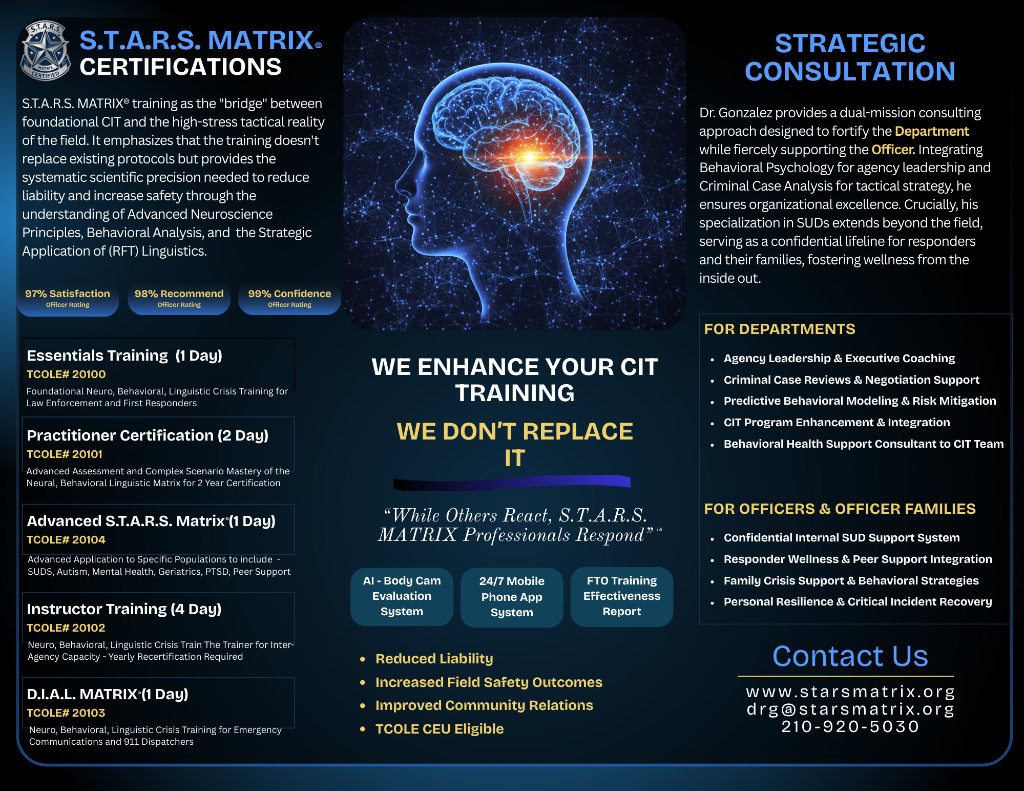
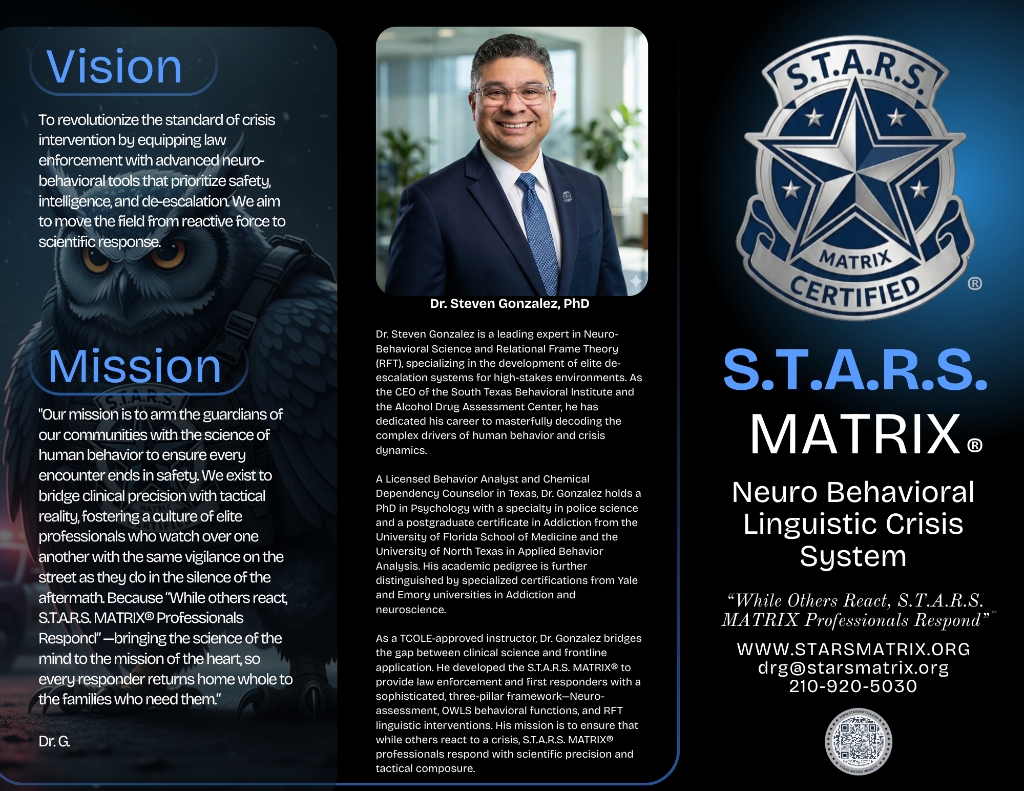
*Use these materials for Academy briefings, shift line-ups, and command staff reviews.
The Coordinator's Playbook: Defining S.T.A.R.S. Matrix® & Why Your Agency Needs It
We built this briefing specifically to arm you with the precise answers your leadership will demand regarding program utility, tactical differentiation, and operational necessity.
Dr. Gonzalez designed this system so LEOs can learn and teach the technical science. We don't teach "feelings"—we teach biological mechanics. Officers buy in because they see immediate tactical advantages: ending resistance faster, reducing physical struggle, and keeping them out of Internal Affairs by avoiding unnecessary force.
S.T.A.R.S. Matrix resides "alongside" your UoF policy. It provides the biological stabilization required for tactical communication to work. If a threat is immediate, standard UoF applies. We give officers the tools to prevent a situation from ever reaching that threshold whenever biologically possible.
Yes. Through our Instructor Certification (4 Day), we train your team to become the experts. This allows you to integrate S.T.A.R.S. training into regular in-service cycles or even 15-minute shift briefings, eliminating the need for massive overtime backfills or pulling half the agency off the street.
Zero weaponization. The AI dashboard is an objective coaching tool. Data ownership stays with the agency. We recommend a strict "Non-Disciplinary" policy for AI-driven feedback, focusing purely on skill development and liability reduction. It protects the officer as much as the agency.
ROI is measured in three hard categories: Lowered Settlement Costs (preventing civil rights litigation), Reduced Workers' Comp (lowering officer PTSD/burnout claims), and Lower Turnover. By preventing just one avoidable Use of Force settlement, the program pays for itself for the next decade.
Financial Investment & Funding Strategies
We partner with agencies to ensure deployment is financially viable and maximizes existing external funding sources.
Strategic Pricing Model
We do not use a "one-size-fits-all" pricing model because every agency's infrastructure needs are different (e.g., Patrol only vs. Dispatch + Command Staff rollout).
During our initial consultation, we audit your agency's scale and specific challenges to build a customized, financially responsible deployment plan.
Common Funding Streams
The direct cost to your operating budget is often negligible. S.T.A.R.S. Matrix® deployments are frequently funded through:
- ▸ State & Federal Training Grants
- ▸ Asset Forfeiture Funds
- ▸ Existing CEU Budgets
- ▸ Risk Management/Insurance Subsidies (for liability reduction)
Ready to Give Your Officers the Tools They Need?
Schedule a confidential consultation with Dr. Steven Gonzalez and the S.T.A.R.S. Matrix® team. We'll discuss your agency's specific needs and show you how S.T.A.R.S. Matrix® can transform your crisis response capability.
Schedule Your ConsultationSECURE CHANNEL: DRG@STARSMATRIX.ORG
DIRECT LINE: 210-920-5030
WWW.STARSMATRIX.ORG